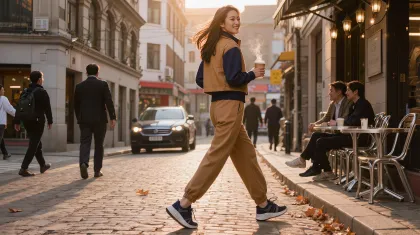
Kyoto in July doesn't do dry. It does oppressive, shirt-sticking-to-your-spine wet heat that hits you the moment you step off the Haruka Express at Kyoto Station. Thirty-seven degrees Celsius, ninety percent humidity, and air so thick you could chew it. I'd brought one personal item—a 35-liter backpack—based on a three-year-old blog post claiming summer in Kansai was "mild."

The vintage aesthetic I was aiming for felt less romantic and more like a costume malfunction waiting to happen. But I'd committed. One bag. Dusty rose and deep wine tones. No synthetic trends that would melt in the sun or stink after one tram ride.
I stood on Platform 0, sweating through my Uniqlo merino before I'd even left the station, wondering if my careful planning had finally met its match in Japanese summer.
The Fabric Strategy for 37-Degree Monsoons
You can't out-pack humidity. You can only outsmart it with fiber choice.
I wore an Uniqlo extra-fine merino crew neck in dusty rose every other day for two weeks straight. Merino doesn't hold odor—it releases bacteria into the wash instead of trapping it in synthetic pores.
It wicks moisture vertically, pulling sweat away from your skin so you don't feel clammy when you step from 37-degree heat into over-air-conditioned museum lobbies. And it dries overnight in a bathroom with the exhaust fan running, which matters when you're hand-washing in a sink at midnight with a bar of hotel soap.
Cotton would have mildewed in that bag by day three.
My skirt was heavy Belgian linen from COS—not the crisp kind that wrinkles if you look at it, but the slubby, washed variety that actually gets softer when you sweat into it. Linen creates micro-vents between your skin and the weave.
At 30 degrees Celsius, that's engineering, not fashion. The burgundy color deepened when damp, hiding the sweat marks that would have shown on black or navy.
Fair warning: linen shrinks if you hot-wash it. Cold water only. And hang dry. Always. I learned that in Lisbon the hard way when a favorite dress became a crop top.
Invest in fabric over trends. A fast-fashion tee lasts three washes in this climate. My merino survived fourteen days and still smelled neutral.
Kyoto Gion by Bicycle: The Flat Truth
You don't need the bus. You need a bicycle.
Kyoto is flatter than a crepe. The bike lanes are painted mint green and run parallel to the Kamo River, separated from traffic by concrete barriers that keep you safe from the taxis. I rented a mama-chari with a front basket from a shop near the station for ¥800 per day.
No gears, just momentum and a bell that sounded like a frog croaking. The seat was vinyl and slightly torn, sticking to my thighs through the cotton blend of my shorts in a way I won't romanticize.
Gion Corner hosts geisha performances at 6 PM and 7 PM in a wooden hall that smells of tatami mats and rosin. The Miyako Odori dances are precise, mechanical, beautiful. Their silk kimonos—heavy, embroidered, worth more than my entire backpack—didn't show sweat. I checked my own blouse and was grateful for the loose weave.
But the temples—Nanzen-ji with its massive Sanmon gate, Eikan-do with its curved bridge and maple trees, Chion-in with its giant bell that requires seventeen monks to ring—close at 5 PM sharp. No exceptions. The monks lock the gates with a metallic clang you can hear from the street, echoing off the stone walls like a dinner bell.
I pedaled from the Philosopher's Path to Nishiki Market in twelve minutes, the wind creating a temporary relief from the humidity that otherwise felt like wearing a wet wool blanket. The air smelled of sandalwood incense drifting from every temple doorway—sweet, woody, slightly medicinal.
It clung to my linen skirt more than the sweat did, embedding itself in the fibers so that when I unpacked back in Tokyo, I could still smell Kyoto.
Standing on Marble: The Gallery Test
Marble floors kill feet. So do four hours of standing in climate-controlled rooms that somehow feel colder than the heat outside, creating condensation on your water bottle the moment you step inside.
My museum day outfit was a pair of high-waisted burgundy trousers from & Other Stories—cotton with 2% elastane for squatting down to read the small placards at the National Museum of Modern Art without splitting a seam.
The blush silk blouse was a calculated risk. Silk sweats. But this one was habotai, tightly woven and thrifted from a 1980s Japanese designer, loose enough that air moved through the armholes like bellows as I walked.
My ombre nude-to-blush nails clicked against the museum map as I traced the route from the permanent collection to the special exhibit, the gradient from ivory to rose catching the fluorescent lights.
Then came the wine. A natural wine bar near the Kamo River, outdoor seating on wooden crates, a glass of local Cabernet Franc that tasted like berries and dirt and summer rain. Someone bumped the table.
The glass tilted. Red wine arced through the humid air and landed squarely on my left sleeve, splashing onto the linen skirt hem with a sound like a sigh.
Here's the thing about investing in fabric: that silk was tightly woven, high momme weight. The wine beaded instead of soaking immediately, sitting on top of the fiber like mercury. I blotted it with the soda water from my water bottle in thirty seconds, dabbing rather than rubbing.
No stain. If it had been polyester or a cheap viscose blend, it would have set into the fibers before I could react, creating a pinkish Rorschach test. The burgundy trousers hid the few drops that missed my sleeve entirely.
Crisis averted by cloth quality, not quick thinking.
Rain-Proofing the Vintage Look
Rain in 37-degree heat is insulting. It's also inevitable every afternoon around three, when the sky turns the color of old bruises and opens up without warning.
I carried a packable anorak from Everlane in deep oxblood. Nylon shell, no lining, purchased three years ago and tested in similar conditions during my SoHo winter gallery trip. It stuffed into its own pocket the size of a grapefruit and lived at the bottom of my backpack, taking up the space most people waste on a third pair of shoes.
When the downpour hit just before four—sudden, violent, tropical—I threw it over my linen skirt and looked like a 1970s safari tourist who got lost in a garden. Which was exactly the aesthetic I was aiming for.
The key to one-bag travel, as I learned during my Ginza shopping day with earth tones, is color continuity. Burgundy anorak, burgundy trousers, blush base layers. When you're limited to 35 liters, every item must coordinate with every other item.
The rain didn't ruin the photos at the Heian Shrine gardens. It made the gray gravel darker, the green maples neon, and the vermillion torii gates bleed color into the wet air, creating reflections on the stones that looked like oil paintings.
Fair warning: packable rain jackets trap heat. I only wore mine during actual precipitation, which lasted roughly twenty minutes but felt like a steam bath. The rest of the time, the jacket added zero weight and zero bulk.
Nishiki Market and the 5 PM Shutdown
You can't subsist on temple incense. You need mochi.
Nishiki Market stretches for five blocks under a covered arcade, the ceiling low enough that you feel the press of humanity and humidity together, condensation dripping from the metal beams onto your shoulders. Samples cost ¥300—about €1.80—sticky rice balls filled with red bean paste, handed over on squares of wax paper that immediately go transparent with grease.
I ate mine standing in an alleyway between a pickle shop and a knife sharpener, watching the shopkeepers roll down their metal shutters precisely at five o'clock, the clatter drowning out the cicadas.
The rhythm of Kyoto is dictated by temple hours. Open at nine, close at five. No late entries, no sunset photography inside the gates, no exceptions for tourists who lost track of time browsing ceramics.
I pedaled hard to reach Eikan-do by quarter to five, my skirt hiked up to my knees to avoid the bike chain, the bell ringing at pedestrians who wandered into the mint-green lanes. I made it with three minutes to spare.
The monk at the gate nodded at my outfit—modest enough, shoulders covered by the merino tee, knees below the linen hem—and let me through without a word.
The evening light at four-fifty is gold and heavy, cutting through the humidity in visible shafts. It hit the burgundy linen and turned it almost black. My merino was damp but presentable. The anorak was back in the bag. I'd survived the humidity, the twelve-minute bike sprint, the wine spill, and the strict dress codes.
And I still had room in my bag for mochi.
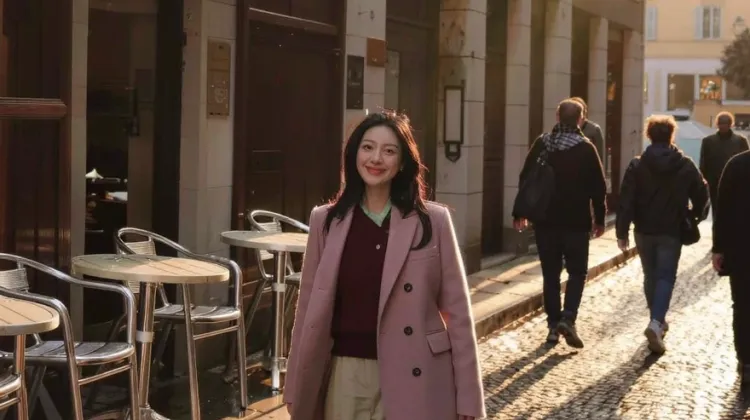
The Personal Item Temple Checklist
Traveling with one bag requires surgical precision. Everything must earn its place.
• Uniqlo extra-fine merino crew neck (dusty rose): Worn six times, washed four, never smelled.
• COS washed linen midi skirt (burgundy): Dried in three hours post-wash, hid sweat and wine.
• & Other Stories cotton trousers (burgundy): 2% elastane allowed full temple-squat range.
• Everlane packable anorak (oxblood): Compressed to grapefruit size, weighed nearly nothing.
• Thrifted habotai silk blouse (blush): Loose weave allowed airflow, tight weave repelled liquid.
• One pair leather sandals: Survived cobblestones and bike pedals.
• One crossbody bag: Small enough to fit inside the backpack for flights, used daily for temples.
No checked luggage. No backup outfits. Just fabric that works harder than you do.
What fabric works best for Kyoto's summer humidity?
Uniqlo extra-fine merino wool for odor resistance and COS Belgian linen for breathability. The merino releases bacteria in the wash rather than trapping it, and the linen gets softer when you sweat into it rather than mildewing in a packed bag.
How do you travel between Kyoto temples efficiently?
Rent a mama-chari bicycle with a front basket. The flat city has mint-green bike lanes that let you bypass bus queues while the wind provides relief from the humidity and the smell of sandalwood drifts from temple doorways.
What should you wear for temple-hopping that respects dress codes?
High-waisted cotton trousers from & Other Stories with 2% elastane for squatting, paired with loose silk blouses. The burgundy color hides bicycle chain grease, and the modest cut passes inspection at Eikan-do's entrance gates.
How do you handle rain with only a personal item bag?
A packable oxblood anorak from Everlane that compresses into its own pocket. It adds zero bulk to a 35-liter backpack and coordinates with blush-burgundy palettes, eliminating the need for single-use rain gear.
Why invest in expensive fabrics for travel?
Quality cloth survives accidents. When Cabernet Franc spilled on my thrifted habotai silk blouse, the tight weave made the wine bead instead of soak, saving the garment where polyester would have stained permanently.