The Zipper Test
The zipper groaned.
I was sitting cross-legged on my apartment floor, attempting to wedge a week's worth of July survival into a bag that measured exactly forty centimeters tall. Not forty-one. Not "it fits if I squish it." Strictly under-seat dimensions, because I wasn't paying for overhead bin privilege on this trip.
The bag was navy ballistic nylon, bought three years ago from Everlane during a panic about sustainability, and it had already survived Crete Spring Packing and Mykonos Fall Style. It smelled faintly of sandalwood and airport floor.
[IMAGE: navy bag packed with visible camel trousers]
My packing list was militant:
• COS cotton-linen trousers (sixty percent cotton, forty percent linen, the only blend that doesn't wrinkle into origami when humidity hits ninety percent)
• Uniqlo superfine merino crew neck (eighteen-point-five micron, odor-resistant for three wears minimum)
• Zara ribbed tank with three percent elastane (key stretch for high humidity)
• & Other Stories midnight silk camisole (weighs ninety grams, looks like evening)
• Mango leather slides (genuine leather with arch support, survived Lisbon cobblestones previously)
• The mandatory compact umbrella (purchased at Olive Young for ₩4,000 after the first one died)
The linen breathes. That's the thing about Seoul in monsoon season. Twenty-five degrees at dawn, thirty-three by noon, and the air feels like you're breathing through a wet flannel. Cotton suffocates. Polyester betrays you. But the blend holds structure while letting your skin actually function.
I know the merino works because I tested it for four days straight in Nepal, and Nepal Unfiltered chaos involved dust and bus rides that would break lesser fabrics. In Seoul, it served as my airplane layer, my café layer, and my "the AC is set to Arctic" layer.
Not gonna lie, packing for one bag is a trust exercise with yourself. You have to believe you won't need options. You need the right things.
Seoul Arrival: AREX and the Merino Experiment
The AREX express from Incheon Airport took forty-three minutes exactly. ₩9,500. I bought the ticket from a machine that beeped aggressively at my foreign card until I switched to cash. The train was clean in a way that makes you conscious of your own crumbs.
I stood for the first two stops, hovering near the doors with my bag between my ankles, unwilling to break the seal on my packing job.
By the time we hit Seoul Station, the wool was already working. The train car was seventeen degrees Celsius. My skin was twenty. The merino regulated in that magical way it does, wicking sweat from the platform heat and then insulating against the artificial cold.
I stepped onto the platform around ten in the morning, and the humidity hit me like a wall of wet silk.
The walk to the metro transfer involved a staircase that seemed designed to test luggage wheels. Mine passed. I took the Line 4 toward Myeongdong, pressed between commuters holding iced Americanos in cups that dripped condensation onto my khakis.
The smell of the station was concrete and green tea extract and the faint chemical sweetness of hairspray from the woman next to me.
Myeongdong Noise and Gradient Nails
Myeongdong at eleven in the morning is a sensory assault dressed as shopping. Every storefront blasts a different K-pop track, creating a layered soundtrack of bass drops and synthesized vocals that follows you down the street like an overenthusiastic puppy.
I walked past skin-care shops with employees handing out samples of snail mucin and rice toner, their voices pitched high and musical against the noise. The visual chaos is specific: neon signs in hangul, mannequins wearing bucket hats and oversized blazers, the glitter of cosmetic store facades reflecting the gray sky.
[IMAGE: Myeongdong street with neon signs and crowd]
I stopped at a corner place with mismatched chairs and a chalkboard menu written in purple marker. The iced vanilla latte cost ₩6,500, which felt expensive until I realized the cup was the size of my face.
I sat by the window, watching the crowd navigate around puddles from the morning's rain, and noticed my hands wrapped around the cold glass. The gradient on my nails—pale beige at the base, deepening to a dusty rose at the tips—caught the light.
It was subtle. The kind of thing you notice when you're fidgeting with a straw wrapper, wondering if your outfit reads "effortless" or "I gave up."
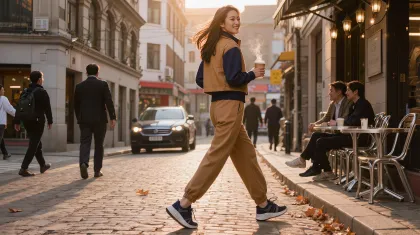
The trousers were holding up. The navy tank top I'd worn underneath—the Zara ribbed cotton number with three percent elastane—was dark enough to hide sweat patches but light enough to let me move.
I felt the fabric pull slightly as I reached for my bag, the give of the elastane preventing that restrictive feeling you get with pure cotton in high humidity. Outside, a group of teenagers walked past in coordinated athleisure, their nails longer and more elaborate than mine, acrylic sculptures that clicked against their phone screens.
Mine were quieter. But they felt sophisticated against the camel cotton, a small signal that I understood the assignment.
The ₩8,000 Lunch That Changed Everything
The bibimbap lunch set changed my afternoon. ₩8,000. Five euros and fifty cents. The restaurant was underground, down a staircase that smelled like sesame oil and fermented soybean paste. I ordered by pointing at a plastic model in the window—rice, spinach, bean sprouts, gochujang, a fried egg on top that still had runny yolk when the stone bowl arrived.
[IMAGE: steaming stone bowl bibimbap on wooden table]
The bowl was volcanic. Literally hot enough to keep cooking the rice for ten minutes after it hit the table. I mixed it with a metal spoon, listening to the sizzle, feeling the steam hit my face and mingle with the sweat already there.
The texture of the gochujang was gritty and sweet and hot, sticking to the spoon in a way that required licking. The rice at the bottom turned crispy, golden, requiring scraping with the edge of the spoon to lift the soccarat-like crust.
I ate with my right hand while my left hand gripped the folded umbrella between my knees. The umbrella was non-negotiable. July in Seoul means rain that arrives without invitation, sudden and vertical. Mine was a compact black number from Olive Young that I'd bought for ₩4,000 when my first one inverted in a gust near the Cheonggyecheon stream.
It folded down to twenty-eight centimeters, which meant it fit in the side pocket of my bag without disturbing the clothing architecture.
Starfield to Rooftop: One Bag, Two Moods
Starfield Library in COEX Mall is thirteen meters of architectural theater. Floor-to-ceiling shelves filled with books in Korean and English, arranged by color rather than subject, creating a visual gradient that makes the whole space feel like a set design.
I walked there from the restaurant, a twenty-minute stroll through underground passages that offered relief from the thirty-degree heat above. The mall air was dry and smelled like new carpet and luxury handbags.
Inside the library, the temperature dropped to twenty-one degrees. The smell was paper and expensive HVAC filtration. I sat on the lowest tier of the steps, not because I needed to read, but because my feet hurt in a specific way that only happens when you've walked five kilometers in leather sandals that are still breaking in.
The tan lines on my feet had become permanent fixtures by day three—stripes of bronze against the pale skin where the leather straps sat. They looked ridiculous. They looked like proof.
I pulled the & Other Stories silk camisole from my bag. It was midnight blue, crumpled into a packing cube the size of a paperback, and it weighed nothing. In the bathroom stall, I changed out of the sweaty tank and into the silk, letting the camel trousers stay because they were dry now and looked intentional.
The silk caught the light differently than cotton. It looked like evening. It looked like I hadn't just spent the day trudging through monsoon humidity.
One good bag and the right fabrics eliminate the need for a hotel room between day and night.
Bukchon After Dark: Two Hands on the Bottle
Bukchon Hanok Village sits on a hill north of the river, a maze of traditional Korean houses with curved tiled roofs that look like they're sleeping. I arrived around seven, just as the blue hour was settling in and the heat was finally breaking.
The temperature dropped to twenty-six degrees, and the air smelled like woodsmoke from someone's dinner and the jasmine that grows over courtyard walls. The walk up involved cobblestones that tested the soles of my Mango slides—genuine leather with arch support that I'd bought after destroying cheaper versions in Lisbon.
[IMAGE: Bukchon hanok village at blue hour]
I met a friend there—someone I'd known from a previous trip, a local who insisted on showing me the "real" side of the neighborhood away from the main tourist drag. We ended up at a tiny restaurant with four tables, eating grilled mackerel and drinking soju from green bottles.
And then the etiquette lesson happened. I reached for the bottle to pour her mother a shot, using one hand, the way I would at home. The correction was instant and gentle—she placed her other hand under my elbow, guiding me to support my pouring arm with my free hand.
Two hands for elders. It's a gesture of respect that changes the physics of the motion. You have to slow down. You have to be present. The glass becomes heavier, or maybe you just notice the weight more.
Not gonna lie, I felt clumsy for the first three pours. The fourth felt like meditation.
We stayed until nearly ten, watching the lights from the modern skyscrapers beyond the traditional rooflines. My sandals stayed on because the restaurant required shoe removal, and I saw the extent of the tan lines in the dim light—ridiculous stripes that would last until October.
The navy silk camisole had developed a slight sheen from the humidity, but it looked expensive that way. Like I'd planned it.
The AREX back to the airport the next morning was quieter. I stood again, holding the overhead rail with one hand, checking my bag with the other to make sure the zipper hadn't given up. It held.
What's the best fabric for Seoul's humid summer?
My COS cotton-linen trousers survived thirty-three-degree heat because the sixty-forty blend dries in twenty minutes near an AC vent, unlike pure cotton which stays damp. For tops, Uniqlo's eighteen-point-five micron merino wool regulates body temperature between freezing subway cars and sweltering streets without developing odor.
How do you pack for personal item only travel to Korea?
I limited myself to a forty-centimeter navy bag and packed items that served triple duty: a Zara ribbed tank with elastane for stretch, a silk camisole that works for dinner, and an umbrella bought at Olive Young for ₩4,000 when the first one snapped. The key is choosing fabrics like merino and cotton-linen that don't wrinkle or smell.
How much does the airport train cost from Incheon to Seoul?
The AREX express costs ₩9,500 and takes exactly forty-three minutes to reach Seoul Station. I bought my ticket with cash after my foreign card failed at the machine, and stood for the ride to avoid unpacking my bag from the overhead rack.
What's the drinking etiquette for older Koreans?
When pouring soju for anyone older, use both hands—one on the bottle, one supporting your pouring arm or under the elbow. I learned this at a Bukchon restaurant when my friend corrected my one-handed pour. It slows down the gesture and signals respect.