I was three bites into the pesto bruschette when I realized the shirt hadn't betrayed me yet. Sweat was still evaporating from my collarbone — we'd climbed the stairs from the harbor in Manarola at a pace that could only be described as ambitious — but the olive cotton-nylon blend wasn't clinging.
It was doing that thing good fabric does where it creates space between your skin and the cloth.
The terrace at Nessun Dorma fills up fast around six-thirty. Tables of couples in freshly pressed linens claiming the view while I sat there with saltwater drying tight on my forearms. That specific tightness you get when you've swum in the morning and haven't quite showered yet.
Monterosso al Mare, by the way. The only village of the five with actual sand between your toes instead of rocks that demand respect.
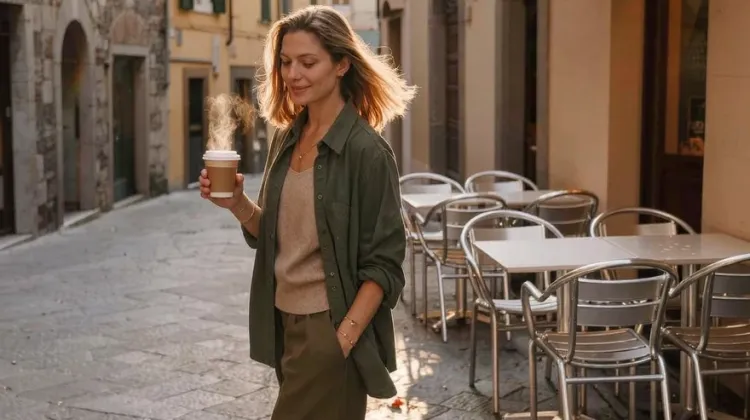
I'd been wearing these trousers for four days straight. The same oatmeal base layer underneath since Tuesday. It was Friday. This is what happens when you commit to two weeks with only a backpack — you either master sink laundry or you get very honest about which fibers can handle grape harvests in twenty-one degree heat.
The bruschette was gone. I ordered another spritz and watched a woman across the terrace unpack a tote bag containing three outfit changes and a hair straightener. I recognized that panic. That used to be me — the woman who thought hiking then dinner required actual separate costumes.
My nails — pale-tipped and chipped at the thumb from gripping train poles — looked intentional against the olive green sleeve as I reached for my glass. The manicure had survived the Positano stairs and saltwater better than my hair, which we'll get to.
You Don't Drive to Cinque Terre, You Submit
Everyone spends three hours on travel forums trying to figure out how to park in Riomaggiore. The answer is you don't. I left the rental at the Garage Centrale in La Spezia — it's near the port, cost around €15 daily — and surrendered to the Regionale train line.
The Cinque Terre Treno MS Card costs €16. Covers unlimited trains between Levanto and La Spezia for the day, plus access to the hiking trails. I bought mine at the station bar just before ten in the morning, nursing a coffee that tasted like burnt chestnuts and diesel fumes.
Twenty-three minutes later I stepped onto the platform at Manarola. The air smelled different there. Like wet stone and ripe grapes and the metal tang of the fishing boats. You cannot drive between the villages — the roads exist in theory but in practice they're one-way nightmares reserved for delivery vans and the very brave.
This constraint saves you from yourself. When you know you're carrying everything up those stairs — and there are always stairs — you suddenly become very honest about what you actually need.
I learned this the hard way last April, trying to navigate Lyon's funicular in a suede blazer that soaked up rain like a sponge. That trip taught me everything about dressing for transit — specifically that if you're taking public transportation, your clothes need to survive being packed, unpacked, rained on, and sat in.
Why I Packed Like Someone with a Very Small Closet
I used to pack for aspirational selves. The woman who wears silk to breakfast and heels on cobblestones. Last spring I brought three blazers, two skirts, and heels to Lyon. Wore sneakers and the same jeans for five days straight while it rained. Never again.
For this trip I committed to a narrow palette. Muddy greens and beiges. Colors that hide dust and match each other without thought. Specifically:
Uniqlo's extra-fine merino turtleneck in oatmeal. The kind that doesn't pill after three washes and doesn't smell even when you're wearing it for the fourth day in a row. Merino is antibacterial — it actually destroys odor molecules rather than masking them.
I wore mine hiking, to dinner, on the train to La Spezia, and to bed once when I was too tired to change.
& Other Stories cotton-nylon utility trousers in dried olive. Sixty-five percent cotton, thirty-three percent nylon, two percent elastane. Water beads up and rolls off instead of soaking in. They stretch when you climb the steps to Corniglia, then snap back into shape by the time you reach the terrace.
That's the difference between a fabric that works and fabric that just looks good on a hanger.

A COS linen-blend overshirt in wet-sand beige that I immediately regretted. The linen was a mistake. It looked like I'd slept in it within two hours of unpacking. Linen breathes beautifully in humid air, yes, but it wrinkles if you look at it aggressively. I ended up using it as a beach cover-up instead of a layer.
The Cinque Terre Trail Test
The Sentiero Azzurro between Manarola and Corniglia is only two kilometers. It feels like twenty when it's twenty-one degrees Celsius and the humidity is sitting at eighty-five percent. I started the hike at around eleven, just as the grape harvesters were hauling crates of Sangiovese up from the terraces.
The smell hit me first. That sweet, fermenting grape must odor that clings to your clothes and hair. Then the sound — not silence, but the specific rustle of dry leaves under boots and the distant snap of pruning shears echoing off the stone walls.
I was wearing the merino base layer under the olive shirt, sleeves rolled to the elbow, the fabric wicking sweat before it could pool in the small of my back.
Merino regulates temperature. When the breeze hit me on the cliffside, I didn't get that clammy chill you get with synthetic polyester. The wool holds warmth next to your skin even when damp. Worth every cent of the thirty-nine dollars.
The trail narrows to a single footpath cut into the cliffside. Agave plants with spikes that look weaponized. I stopped to retie my Blundstones — heavy, yes, but they grip wet stone better than anything I've tested — and noticed my hands against the olive fabric.
The pale-tipped manicure was chipped at the thumb, but the nude-pink against the olive green looked deliberate. Accidentally chic.
We passed terraced vineyards where workers in rubber boots cut bunches with curved knives. The sun was high now, around noon, and the temperature peaked at twenty-two degrees. I could feel salt from yesterday's swim at Monterosso still crystallizing on my shoulders, that tight pull of dried seawater.
Okay so, About the Humidity
The weather app said fifteen degrees and cloudy. It did not say tropical. It did not say that my hair would expand to twice its volume between Corniglia and Vernazza, creating a halo of frizz that no amount of argan oil could tame.
This is where you confront your limitations. I used to pack three hair tools, two straighteners, and a diffuser. Now I pack a claw clip and prayers. The humidity that hangs over the trails in October — during the vendemmia, the grape harvest — is different from summer heat. It's dense. It wraps around you like wet wool.
I ducked into a bar in Vernazza, not the pretty one, the one with plastic chairs and locals watching football on a screen mounted too high. The barman took one look at my neck — sweat and sunscreen mixed into a paste — and handed me a paper napkin without me asking.
That's when I learned that looking put-together has nothing to do with your outfit and everything to do with whether you packed a sweat-wicking base layer.
The drizzle started around four, just as I was heading back toward Manarola. Light rain that wasn't in the forecast. The cotton-nylon trousers darkened at the thighs but didn't soak through. By the time I reached Nessun Dorma, they were dry again.
What Saltwater Does to Your Skin
Monterosso is the only village with a real beach. The others have rocks — beautiful, violent rocks that will bruise your hips if you slip. But Monterosso has sand, coarse and golden, and water that stays surprisingly warm into October.
I swam there on the third morning, around nine-thirty, before the day-trippers arrived from Florence. The water was eighteen degrees, shocking at first then addictive. I floated on my back and watched the sky, then walked back to the station with salt drying white on my shoulders.
Okay so, sitting on that terrace with salt on my skin and olive fabric that had somehow survived both seawater and stair-climbing, I understood something. The outfit wasn't the point. The point was that I wasn't thinking about the outfit.
I was thinking about the pesto. The view. The way the light hits the water at six o'clock when the temperature drops to sixteen degrees and you need that layer you tied around your waist.
I pulled on the light knit — seventy percent merino, thirty percent cashmere from Everlane, purchased two years ago — and ordered the anchovies. The woman with the three outfit changes had left. The terrace was quieter. My clothes smelled like salt and basil and woodsmoke from the kitchen.
What I Learned About Packing Less
The best outfit is the one you don't have to change.
I didn't bring a hairdryer. Didn't bring heels. Didn't bring the silk blouse I'd imagined wearing to dinner. And sitting there on that terrace, watching the sun drop toward the water while wearing the same trousers I'd hiked in, I didn't miss any of it.
The reforming overpacker in me — the woman who once brought four suitcases to Paris — has finally accepted that layers are the only insurance you need. Not options. Not backups. Just one good base layer that doesn't smell, one pair of trousers that stretch and recover, and the humility to know that everyone else at the terrace is too busy looking at the view to notice your creases.
The trail-to-dinner formula isn't about buying expensive clothes. It's about specific fibers doing specific jobs:
- Base layer: Uniqlo extra-fine merino (or any merino). Wear it four days. It won't smell because the wool fibers are naturally antimicrobial.
- Trousers: Cotton-nylon blend with 2% elastane. The nylon provides water-resistance, the cotton provides breathability, the elastane means you can climb stairs without the knees bagging out.
- Shoes: Anything with a grippy Vibram or rubber sole that can handle wet stone. I wear Blundstones because they're heavy enough to feel grounded but not so heavy they weigh down a carry-on.
- The €16 card: Buy it at La Spezia station. Don't try to buy individual tickets for each train.
- Hair strategy: Accept the frizz. Or bring a hat. But mostly accept it.
The temperature dropped fast after seven. I tied the knit around my shoulders and walked down to the harbor, the olive trousers moving with me instead of against me. Behind me, the lights were coming on at Nessun Dorma.
Ahead, the train back to La Spezia. I had sand in my shoes and salt in my hair and I didn't need to change a thing.
What outfit works for both hiking and dinner in Cinque Terre?
I wore Uniqlo's extra-fine merino turtleneck as a base layer with & Other Stories cotton-nylon utility trousers in olive. The merino resists odor for days of hiking, and the cotton-nylon blend stretches for climbing stairs but looks structured enough for dinner at Nessun Dorma.
How do I get to Cinque Terre with a car?
Park at Garage Centrale in La Spezia near the port, then take the Regionale train. Buy the Cinque Terre Treno MS Card at the station for unlimited trains between villages and trail access. Individual tickets add up quickly compared to the daily pass.
Which fabrics survive humidity and rain in Italy?
Merino wool regulates temperature and doesn't smell even after four days of hiking because the fibers are naturally antibacterial. Cotton-nylon blends repel light rain and dry quickly without wrinkling. Avoid pure linen for humid conditions — it creases immediately and looks disheveled by lunch.
Is the Cinque Terre Card worth buying?
Yes, if you're hiking and using trains. The card covers the Sentiero Azzurro trail access and unlimited regional trains between La Spezia and Levanto. Individual train tickets cost significantly more per journey, so the card pays for itself after three rides.
What should I pack for Cinque Terre in October?
Pack merino base layers for temperature regulation, cotton-nylon trousers for water resistance, and a light merino-cashmere knit for when temperatures drop to sixteen degrees after sunset. Leave the hair tools at home — the humidity during grape harvest season will undo any styling within minutes.